Digital Identity and Digital Tools in Italy: Complete Guide for Citizens and Professionals
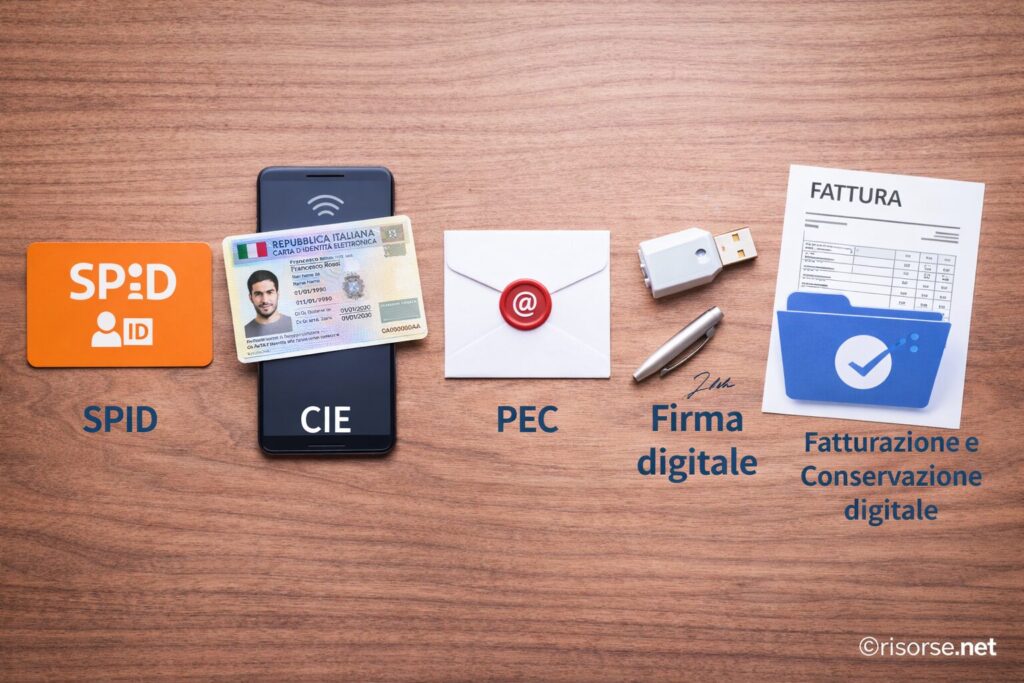
Administrative digitalization in Italy revolves around tools like SPID, CIE, PEC, digital signature, electronic invoicing, and compliant digital preservation. Each has a specific function and they are not interchangeable. In this comprehensive guide, we explain what they are, how they work, and how they integrate with each other for citizens, professionals, and businesses.
In recent years, Italy has accelerated the process of administrative digitalization. Today, citizens, professionals, and businesses use tools like SPID, CIE, PEC, digital signature, electronic invoicing, and compliant digital preservation to manage procedures, documents, and official communications. Understanding how they work and when they are truly needed is essential to avoid mistakes and work in compliance with regulations.
Digital identity is the set of tools that allow you to identify yourself online to access services of the Public Administration and private entities. In Italy, the main identification tools are SPID and CIE.
SPID and CIE: tools to access online services
SPID (Public Digital Identity System) allows access to online services through personal credentials. It is currently the most used tool to enter PA portals. The CIE (Electronic Identity Card) is a physical document that can also be used as a digital identity via smartphone or NFC reader. For a detailed comparison between the two tools, you can read the dedicated guide: SPID or CIE: which to choose and when it really makes sense.
PEC: communications with legal value
PEC (Certified Electronic Mail) is not used for identification, but to send communications with legal value, equivalent to a registered letter with return receipt. It is mandatory for businesses and professionals registered with a professional body and represents an essential tool in official relations.
The digital signature allows you to sign electronic documents with full legal value. It differs from SPID and CIE because it is not used to access services but to sign contracts, acts, and official documents. It is a fundamental tool for professionals, businesses, and Public Administration.
Electronic invoicing has revolutionized fiscal management in Italy. Invoices must be issued in XML format and transmitted via the Interchange System. It is not just digital submission: it entails specific archiving and management obligations.
Compliant digital preservation: legal document archiving
Saving a document as a PDF does not mean preserving it compliantly. Compliant digital preservation guarantees authenticity, integrity, and legal value over time. It is mandatory for electronic invoices and relevant fiscal documents. Read the guide: Compliant digital preservation: what it is, how it works, and when it is mandatory.
How these tools work together
SPID and CIE are used for identification.
PEC is used for official communication.
Digital signature is used to sign documents.
Electronic invoicing is used for fiscal management.
Digital preservation is used to properly archive documents over time.
They are not alternative tools but complementary. Together they form the digital infrastructure that allows citizens and businesses to operate in a compliant and secure manner within the Italian administrative system.
Frequently asked questions about digital tools in Italy
Do SPID and CIE replace the digital signature?
No. SPID and CIE serve for online identification, while the digital signature is used to sign documents with legal value.
Does PEC replace the digital signature?
No. PEC allows you to send communications with legal value, but it does not replace the digital signature for documents that require signing.
Does electronic invoicing require compliant storage?
Yes, electronic invoices must be digitally stored in compliance for the period required by law.
Is it mandatory to have all these tools?
It depends on your activity. Businesses and professionals have specific obligations, while citizens may need them to access digital services.
Per fornire le migliori esperienze, utilizziamo tecnologie come i cookie per memorizzare e/o accedere alle informazioni del dispositivo. Il consenso a queste tecnologie ci permetterà di elaborare dati come il comportamento di navigazione o ID unici su questo sito. Non acconsentire o ritirare il consenso può influire negativamente su alcune caratteristiche e funzioni.
Funzionale
Always active
L'archiviazione tecnica o l'accesso sono strettamente necessari al fine legittimo di consentire l'uso di un servizio specifico esplicitamente richiesto dall'abbonato o dall'utente, o al solo scopo di effettuare la trasmissione di una comunicazione su una rete di comunicazione elettronica.
Preferenze
L'archiviazione tecnica o l'accesso sono necessari per lo scopo legittimo di memorizzare le preferenze che non sono richieste dall'abbonato o dall'utente.
Statistiche
L'archiviazione tecnica o l'accesso che viene utilizzato esclusivamente per scopi statistici.L'archiviazione tecnica o l'accesso che viene utilizzato esclusivamente per scopi statistici anonimi. Senza un mandato di comparizione, una conformità volontaria da parte del vostro Fornitore di Servizi Internet, o ulteriori registrazioni da parte di terzi, le informazioni memorizzate o recuperate per questo scopo da sole non possono di solito essere utilizzate per l'identificazione.
Marketing
L'archiviazione tecnica o l'accesso sono necessari per creare profili di utenti per inviare pubblicità, o per tracciare l'utente su un sito web o su diversi siti web per scopi di marketing simili.