How to Edit a PDF from Your Smartphone: Android, iPhone, and Free Apps
Editing a PDF from a smartphone is useful when you need to add text, correct a document, annotate a page, fill out a form, or sign a file without using a computer. In this guide, we look at what you can actually do from Android and iPhone, which tools to use, and what limitations to consider.
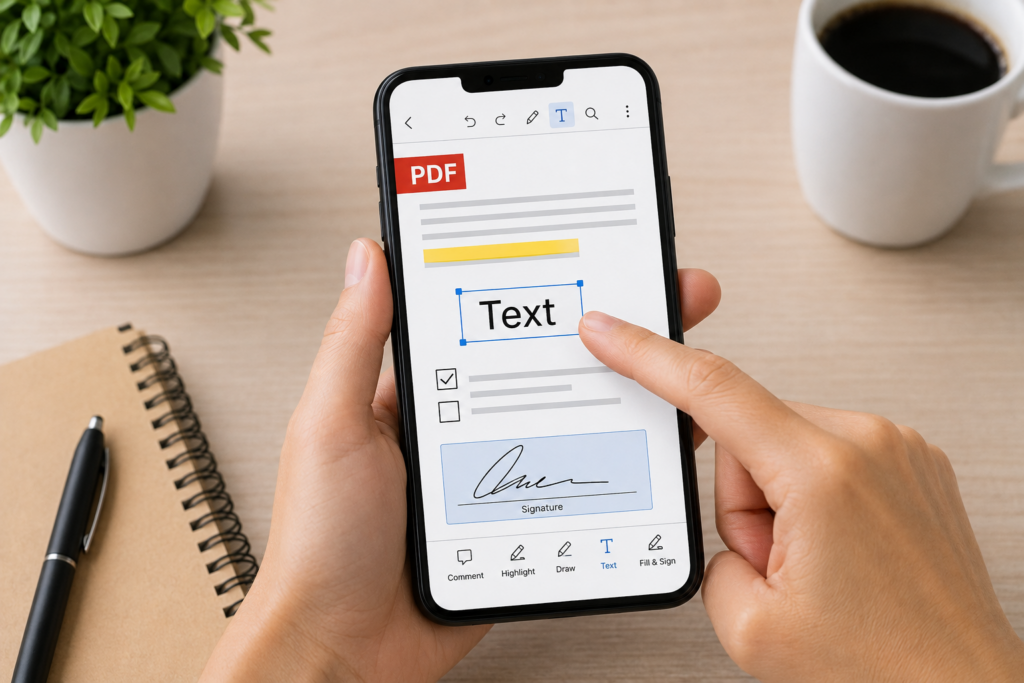
Editing a PDF from a smartphone is useful when you need to quickly work on a document without using a computer. This can happen with forms, receipts, work documents, files to sign, notes, sheets, contracts, scans, or PDFs received via email and chat. With Android and iPhone, you can add text, insert notes, highlight important parts, fill out fields, check boxes, sign the document, save a copy, and send it to the recipient. However, not all edits are the same: it’s one thing to add annotations on a PDF, another to truly modify the original text of the document.
Summary
In this guide we look at how to edit a PDF from a smartphone, which tools to use on Android and iPhone, when the built-in functions are enough, when a dedicated app is needed, and which mistakes to avoid before saving or sending the file.
Helpful note: many smartphone apps allow you to write, annotate, fill out, and sign a PDF, but do not always allow you to modify the original text as you would with a Word document. Before starting, it is important to understand what kind of edit you need to make.
What it means to edit a PDF from a smartphone
When we talk about editing a PDF, very different operations can be meant. Some are simple and easily done from a phone; others require more advanced apps or paid tools. From a smartphone you can often:
add text on top of the document;
fill out pre-set fields;
check boxes;
insert a date;
add notes or comments;
highlight parts of the text;
draw freehand;
sign the PDF;
save an updated copy;
share the edited file.
It is more complex to directly modify sentences, paragraphs, images, or the layout of the original PDF. In that case, a full PDF editor, often with premium features, may be needed.
Editing, filling out, or annotating a PDF: practical differences
Before choosing the right app, it’s best to distinguish between three operations: editing, filling out, and annotating. Filling out a PDF means entering data into form fields: name, date, address, email, phone number, consent checkboxes, or requested information. Annotating a PDF means adding elements on top of the document: notes, comments, highlights, arrows, marks, free text, or hand drawings.
Truly editing a PDF means modifying the original content: changing words already present, deleting sentences, replacing images, fixing the layout, or reorganizing pages. If you only need to fill out fields, boxes, dates, or personal information, you can read the guide on how to fill out a PDF from a smartphone.
How to edit a PDF on iPhone
On iPhone, you can use iOS’s built-in tools for many simple edits: filling out forms, adding annotations, inserting text, signing documents, and sharing the updated file. The process can vary slightly depending on the version of iOS and the app you open the document from, but generally you can proceed as follows:
Open the PDF on iPhone, for example from Files, Mail, Messages, or a cloud app.
Tap the document to view available tools.
Look for the edit, annotation, or markup icon.
If the PDF has fillable fields, tap the field and enter text.
If you want to add free text, use the text or annotation tool.
To highlight or draw, use pen, highlighter, or similar tools.
To sign, add a graphic signature if available.
Review the complete document.
Save or share the edited PDF.
This method is suitable for light edits: notes, signatures, filling out forms, highlighting, and visible corrections. If you need to change the original PDF text, you might require a more advanced editor.
How to edit a PDF on Android
On Android, you can edit or annotate PDFs using built-in features, manufacturer apps, Google Drive, Files by Google, or dedicated PDF apps. The options vary depending on the phone and the app you open the file with. A general path could be this:
Open the PDF on the Android phone.
Check if the app offers editing or annotation tools.
Look for icons like pen, pencil, text, highlighter, or comment.
Add text, marks, highlights, or notes.
If the PDF has fillable fields, tap the fields and enter data.
If you need to sign, use the signature or freehand drawing tool.
Save the document or create a new copy.
Reopen the final file to check that changes are visible.
Google Drive on Android can be useful for freehand annotations with finger or stylus, while for more complete edits you may need to use a dedicated PDF app.
Free apps to edit PDFs from a smartphone
For many simple operations, the tools already on your phone suffice. However, when you need to do something more precise, installing a dedicated app can be helpful. Among the most used solutions are:
Adobe Acrobat Reader mobile: useful to read, annotate, fill, and sign PDFs;
Google Drive: useful on Android to open, save, and annotate PDFs;
Files or File: useful to manage documents and use integrated tools;
Microsoft 365 or Microsoft Lens: useful in some workflows related to documents and scans;
manufacturer’s app: some smartphones include built-in PDF editors or annotation tools.
When choosing an app, always check whether the features you need are free or require a subscription. Some apps allow free annotations and signatures but reserve editing the original text for paid versions.
How to add text to a PDF from a smartphone
Adding text is one of the most common edits. It’s used to insert a note, a date, a name, a number, an address, or a brief correction visible on the document. To do this neatly:
Open the PDF with a compatible app.
Choose the text or annotation tool.
Tap the point where you want to write.
Enter the text.
Adjust size and position, if possible.
Check that the text does not cover important parts.
Save the modified document.
If you are filling out a form, use fillable fields when available. If the PDF has no interactive fields, you can use an overlay text box.
How to highlight, underline, and add notes
Annotations are useful when you need to review a document, mark an important passage, or leave a comment. Many apps allow you to highlight text, underline lines, add sticky notes, or draw freehand. You can use these functions to:
mark a point to check;
highlight a clause;
indicate a correction;
add a margin comment;
highlight a deadline;
review notes or handouts;
comment on a document before sending it.
Before sending the PDF, verify that the annotations are actually saved and visible also when reopening the file from another app.
How to sign a PDF after editing it
Many documents must be edited or filled out first, then signed. In this case, it’s advisable to follow a specific order: first add text, dates, boxes, and corrections; then check everything; only at the end add the signature. A correct sequence can be:
Sometimes the PDF to be edited comes from a photo, a scan, or multiple images combined. In these cases, it is important to understand that the text might not be directly editable: the PDF can be made up of images of the pages, not actual text. If you start from a photo of the document, you can first follow the guide on how to turn a photo into a PDF with Android and iPhone. If instead you need to combine multiple images or create a single document from multiple files, the guide on how to convert images to PDF.
If the document starts from a paper sheet
When the document originates on paper, the first step is not editing the PDF, but scanning. Only after creating a digital file can you add text, notes, signatures, or other elements. The most organized process is:
Not all PDFs are editable in the same way. If you can’t write, change text, or save changes, the problem might depend on the file or the app used. The most common causes are:
the PDF is password protected;
the file is read-only;
the PDF does not contain editable text but images;
the app used only allows viewing;
the editing feature requires a subscription;
the document was created from a scan;
the file is corrupted or not compatible;
changes were saved only as temporary annotations.
In these cases, you can try saving a copy, using a different PDF app, exporting the file to another format, or working on a computer if a more advanced edit is needed.
Editing the original text of a PDF: is it always possible?
Editing the original text of a PDF from a smartphone is not always straightforward. If the PDF was created from a digital document, some advanced apps can recognize and edit the text. However, if the file comes from a scan or a photo, the content might only be an image. To truly edit the original text, you may need:
an advanced PDF editor;
OCR features to recognize text in scans;
a subscription to the app;
a computer, if the document is complex;
the original file in Word, Google Docs, or another editable format.
For many daily uses, though, you don’t need to edit the original text: it’s enough to add a text box, a note, a signature, or a visible correction.
How to save the modified PDF
After editing the PDF, always check how the file is saved. Some apps update the original document, others create a copy, and others require manual export. The safest choice is to create a copy with a clear name, for example:
document-modified.pdf;
form-filled.pdf;
document-signed.pdf;
contract-annotated.pdf;
request-updated.pdf.
Keeping the original file is helpful if you need to fix errors, compare versions, or redo the edit.
How to send the modified PDF
Once saved, you can send the modified PDF via email, WhatsApp, cloud, or online portal. For important documents, it’s better to send it as an attached file and not as an image. You can share it via:
email;
WhatsApp as a document;
Google Drive;
iCloud Drive;
OneDrive;
Dropbox;
company apps;
online portals.
Before sending, open the final document and verify that all changes are present, readable, and correctly positioned.
Privacy and security when editing PDFs from your phone
A PDF can contain personal data, signatures, addresses, tax codes, financial information, health data, contracts, or confidential content. For this reason, it’s important to carefully choose apps and sharing channels. Before uploading or editing a sensitive PDF:
check the app’s reliability;
read which permissions it requires;
avoid unknown tools for sensitive documents;
do not upload confidential files to unnecessary services;
use screen lock and protected accounts;
do not share documents in unrelated groups or chats;
delete unnecessary copies from downloads or temporary apps.
For very important documents, consider using only official tools or those indicated by the recipient.
Table: which method to use to edit a PDF from a smartphone
The choice of method depends on the type of editing you need to do.
Operation
Recommended method
When to use it
Add text
Text or annotation tool
For notes, dates, names, and visible corrections
Fill out a form
Fillable fields or PDF app
When the PDF contains spaces to fill
Sign the document
Graphic signature or PDF app
When you need to add a visible signature
Highlight or comment
Markup tools
To review, study, or comment on a file
Edit original text
Advanced PDF editor
When you need to change words already present in the document
PDF from scanning
OCR or annotations
When the document consists of images of the pages
Save a copy
Export or save as a new file
To also keep the original PDF
Mistakes to avoid
Editing a PDF from a smartphone is convenient, but some mistakes can make the file hard to read or difficult to use.
Confusing annotation with actual editing: adding text over the PDF does not always mean changing the original content.
Not saving a copy: it’s better to also keep the original document.
Using unreliable apps: be cautious with PDFs containing personal data or signatures.
Writing too small: the added text must be readable.
Covering important parts: notes and boxes should not hide content.
Sending the PDF without reopening it: always check the final file.
Using the wrong format: if the recipient requests a PDF, do not send screenshots or separate images.
Signing before correcting: if you need to sign, do so only after completing all edits.
In summary
Editing a PDF from a smartphone is possible, but it depends on the type of edit you need to make. To add text, notes, highlights, signatures, or fill out forms, Android and iPhone offer several simple solutions. To edit the original text or work with complex files, a more advanced PDF editor may be required. The most important thing is to understand whether you need to fill out, annotate, sign, or actually modify the content of the PDF. This distinction prevents mistakes and helps you choose the right app. Before sending the file, always check that the changes are visible, the document is readable, and the final PDF has been saved correctly.
Frequently Asked Questions
Can I edit a PDF from a smartphone?
Yes. You can add text, notes, signatures, highlights, comments, and fill out forms. Editing the original text, however, may require an advanced PDF app.
How do I edit a PDF on iPhone?
Open the PDF from Files, Mail, or another app, use the editing or annotation tools, add text, notes, signature, or fill-ins, and save the updated document.
How do I edit a PDF on Android?
Open the PDF with a compatible app, look for text tools, pen, highlighter, or annotation, add the changes, and save a copy of the file.
Why can’t I edit the text of a PDF?
The PDF might be protected, read-only, created from a scan, or opened with an app that only allows viewing. In other cases, editing the original text requires premium features.
Can I edit a PDF for free from a smartphone?
Yes, for many simple operations like annotating, filling out, signing, or adding text. More advanced edits, such as changing the original text, may require paid apps.
What’s the difference between filling out and editing a PDF?
Filling out means entering data into fields or adding required information. Editing can also mean changing the document’s original content, which is often more complex.
Can I edit a PDF that was created from a photo?
Yes, but often you can only add annotations, text, or signature over the image of the page. To edit the internal text, an OCR function may be needed.
How do I save an edited PDF from my phone?
After editing, use Save, Export, or Save a copy, depending on the app. It is advisable to also keep the original file.
{
“@context”: “https://schema.org”,
“@type”: “FAQPage”,
“mainEntity”: [
{
“@type”: “Question”,
“name”: “Posso modificare un PDF da smartphone?”,
“acceptedAnswer”: {
“@type”: “Answer”,
“text”: “Sì. Puoi aggiungere testo, note, firme, evidenziazioni, commenti e compilare moduli. Modificare il testo originale, invece, può richiedere un’app PDF avanzata.”
}
},
{
“@type”: “Question”,
“name”: “Come modificare un PDF su iPhone?”,
“acceptedAnswer”: {
“@type”: “Answer”,
“text”: “Apri il PDF da File, Mail o un’altra app, usa gli strumenti di modifica o annotazione, aggiungi testo, note, firma o compilazioni e salva il documento aggiornato.”
}
},
{
“@type”: “Question”,
“name”: “Come modificare un PDF su Android?”,
“acceptedAnswer”: {
“@type”: “Answer”,
“text”: “Apri il PDF con un’app compatibile, cerca strumenti di testo, penna, evidenziatore o annotazione, aggiungi le modifiche e salva una copia del file.”
}
},
{
“@type”: “Question”,
“name”: “Perché non riesco a modificare il testo di un PDF?”,
“acceptedAnswer”: {
“@type”: “Answer”,
“text”: “Il PDF potrebbe essere protetto, in sola lettura, creato da una scansione o aperto con un’app che permette solo la visualizzazione. In altri casi la modifica del testo originale richiede funzioni premium.”
}
},
{
“@type”: “Question”,
“name”: “Posso modificare gratis un PDF da smartphone?”,
“acceptedAnswer”: {
“@type”: “Answer”,
“text”: “Sì, per molte operazioni semplici come annotare, compilare, firmare o aggiungere testo. Le modifiche più avanzate, come cambiare il testo originale, possono richiedere app a pagamento.”
}
},
{
“@type”: “Question”,
“name”: “Che differenza c’è tra compilare e modificare un PDF?”,
“acceptedAnswer”: {
“@type”: “Answer”,
“text”: “Compilare significa inserire dati nei campi o aggiungere informazioni richieste. Modificare può significare anche cambiare il contenuto originale del documento, cosa spesso più complessa.”
}
},
{
“@type”: “Question”,
“name”: “Posso modificare un PDF nato da una foto?”,
“acceptedAnswer”: {
“@type”: “Answer”,
“text”: “Sì, ma spesso puoi solo aggiungere annotazioni, testo o firma sopra l’immagine della pagina. Per modificare il testo interno può servire una funzione OCR.”
}
},
{
“@type”: “Question”,
“name”: “Come salvo un PDF modificato dal telefono?”,
“acceptedAnswer”: {
“@type”: “Answer”,
“text”: “Dopo le modifiche, usa Salva, Esporta o Salva una copia, a seconda dell’app. È consigliabile conservare anche il file originale.”
}
}
]
}
Per fornire le migliori esperienze, utilizziamo tecnologie come i cookie per memorizzare e/o accedere alle informazioni del dispositivo. Il consenso a queste tecnologie ci permetterà di elaborare dati come il comportamento di navigazione o ID unici su questo sito. Non acconsentire o ritirare il consenso può influire negativamente su alcune caratteristiche e funzioni.
Funzionale
Always active
L'archiviazione tecnica o l'accesso sono strettamente necessari al fine legittimo di consentire l'uso di un servizio specifico esplicitamente richiesto dall'abbonato o dall'utente, o al solo scopo di effettuare la trasmissione di una comunicazione su una rete di comunicazione elettronica.
Preferenze
L'archiviazione tecnica o l'accesso sono necessari per lo scopo legittimo di memorizzare le preferenze che non sono richieste dall'abbonato o dall'utente.
Statistiche
L'archiviazione tecnica o l'accesso che viene utilizzato esclusivamente per scopi statistici.L'archiviazione tecnica o l'accesso che viene utilizzato esclusivamente per scopi statistici anonimi. Senza un mandato di comparizione, una conformità volontaria da parte del vostro Fornitore di Servizi Internet, o ulteriori registrazioni da parte di terzi, le informazioni memorizzate o recuperate per questo scopo da sole non possono di solito essere utilizzate per l'identificazione.
Marketing
L'archiviazione tecnica o l'accesso sono necessari per creare profili di utenti per inviare pubblicità, o per tracciare l'utente su un sito web o su diversi siti web per scopi di marketing simili.